

Is our questioning justified? Well… yes and no.
Sometimes life just throws you a curveball right when the moon is at its fullest, so sure, it could be a coincidence.
But let’s not forget, we’re made up of around 70% water, and the moon has a very real influence over the tides.
Either way, the moon has earned its reputation as the ultimate scapegoat for our wildest moods and most unpredictable nights.
Some of us may not choose to blame a mood change or a bad day on where the moon is in its lunar phase, but moon moods are a thing; scroll on for everything we know.
Does the moon actually affect your mood?
There’s little scientific evidence to back up the theory that the moon directly affects your mood, but astrologer Tanya Wasylewski shared there’s more to it than superstition.
“In astrology, the moon is deeply connected to our emotions, our inner world and how we care for ourselves,” she explained. “Just as the moon waxes and wanes, our feelings often follow their own natural rhythm.”
Tanya shared that each lunar phase carries its own energetic tone.
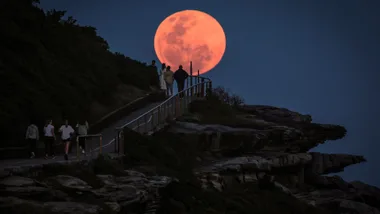
The new moon is a time for rest, reflection and planting seeds, literally and metaphorically. The full moon, on the other hand, is an emotional peak. What’s been sitting underneath often wants to be expressed, released or acknowledged.
While astrology focuses on the moon’s symbolic influence, Tanya pointed out that even those outside the astro world tend to notice its effects.
“Hospitals, police, emergency workers, even parents of toddlers, often report that things seem a little more heightened or unpredictable around the full moon. It’s one of those collective patterns that’s hard to ignore.”
That said, she also clarified that “the moon isn’t a free pass for bad behaviour. Sure, it might amplify what’s already there, but it doesn’t make us do anything. Astrology can offer awareness and insight, but it doesn’t take away our agency or accountability.”
Why do we keep blaming it, then?
For years, people have blamed the moon for all sorts of mood swings and weird behaviour. That’s actually where the word “lunatic” comes from, yep, mental states supposedly shifting with the lunar cycle.
WHO also chatted to Julie Sweet, a clinical psychotherapist and founder of Seaway Counselling and Psychotherapy, who said it’s completely understandable that people look elsewhere when things feel a little off.
“From a clinical perspective, it’s very natural for people to attribute their moods or behaviours to something external, like the moon or Mercury retrograde,” she explained.
“This often reflects a deep human need for control when life feels unpredictable or emotionally overwhelming. We’re natural pattern-seekers — when our inner world feels chaotic, connecting that to something visible, like the moon, can feel grounding.”
According to Julie, believing in cosmic forces can actually provide comfort and connection.

“It reduces self-criticism and normalises emotional responses,” she said. “Hearing someone say ‘it must be a full moon tonight’ can make us feel less alone in what we’re experiencing.”
And while science may not back up the lunar effect, there’s a reason the myth has stuck around for centuries.
“Myths often persist because they hold emotional truth,” Julie added. “They meet psychological and cultural needs — which can provide story, ritual and connection to natural cycles, something especially meaningful in our fast-paced, often digitally detached world.”
Again, these beliefs should also be all about balance.
“It’s critical to maintain curiosity, self-awareness, and openness, recognising the belief as symbolic rather than literal and being willing to explore emotions with professional support if needed,” she explained. “When integrated thoughtfully, this approach can be stabilising and even therapeutic.”
So what does the full moon actually do?
Tanya said the moon acts “less like a controller and more like a mirror for our emotional tides.”
If the moon can move oceans, could it really be subtly tugging at us too?
“Astrology doesn’t depend on the moon’s gravitational pull, but it sees the moon as a mirror for our inner world. Many people notice patterns — perhaps more energised and expressive around the full moon, or more introspective and quiet at the new moon.”
This energy, she added, can show up in simple ways: “feeling more creative, restless, sensitive or ready to let go of what’s been weighing on us.”
So, if blaming the moon helps you feel a little lighter or a little less alone, you’re not totally off base. Just hold the belief loosely, and maybe let it be a reminder to slow down, reflect, and take care of yourself (moonlight optional).

