
YOU COULD WIN $1000
Choose from 14 nominees and go into the draw to win $1000 cash!
Trigger Warning: This article discusses sexual assault and rape.
If you or someone you know has been affected by any of the issues raised in this article, help is always available. Call 1800 RESPECT on 1800 737 732 or visit their website.
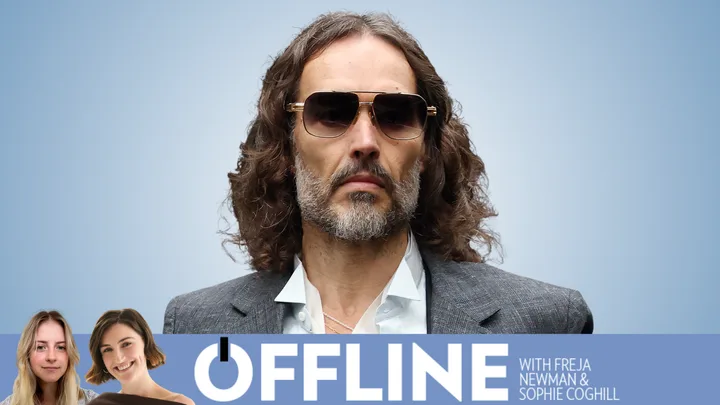
Russell Brand, lewdly cornering a female interviewer on camera. Russell Brand, making graphic remarks to women about their bodies. Russell Brand, casually mentioning rape in a throwaway line.
It feels like the examples are never-ending, one uncomfortable interaction rolling into another, making the women subjected to them uncomfortable, and those watching at home cringe with dread.
If it feels like your social media feed is littered with sexual assault allegations and stories of the latest man not to honour consent, you’re not wrong. Things are feeling really heavy right now, and we’re all feeling scared and exhausted.
But I’m here to share a silver lining with you.
Lawyer Jahan Kalantar spoke to WHO about how public conversation can shift what counts as an ‘acceptable sentence’, giving us reason to keep pushing forward, even when we feel so disheartened.
Russell Brand has been sentenced to more than a decade in prison
Brand was convicted of raping one woman and sexually assaulting three others last week, and was sentenced to more than a decade in prison.
It’s cause for bittersweet celebration, because crimes like this are exceptionally hard to prove in the justice system.
Brand continues to deny the charges, maintaining his encounters were consensual – reiterating this belief in a statement read by his wife, Laura Brand, on their YouTube channel.
Why we need to keep making noise
While many feel that 10.5 years is not nearly enough for the crimes of which Brand is accused, it’s worth acknowledging that the sentence could have been far less had it been handed down at a different time.
While Kalantar explained that judges are “very good” at keeping public conversation and “noise” out of the courtroom, he also concedes that ultimately, they’re still human.
“So judges have a lot more information than the rest of us, and they tend to be very, very good at keeping the zeitgeist out and dealing with matters of law,” he told WHO. “But all judges are humans, and so I think we need to accept that the zeitgeist does play a role.”
The more that sexual assault is front and centre in public conversation – from #MeToo to the Cornell Case, Jeffrey Epstein and beyond, the more the range of what is deemed an “acceptable sentence” shifts too.
“So if the range is breached by virtue of the punishment being too severe, that would be grounds for an appeal. And if the range is breached by the punishment being too lenient, that would be grounds for an appeal,” he explained.
“What you can say, and what I have certainly found, is that different judicial offices will look at cases with a different perspective.
“And I think that you have to accept to some extent that the law is psychological and not simply logical, which means that current social issues inevitably, because of a person’s exposure to them, will have them at the forefront of their mind.”
So basically the message is this: don’t stop standing up for the women you love, for the women you don’t know, and for the woman that you are.
The noise is excruciating, but it’s moving the needle.
“The answer is quite simple,” Kalantar said. “Bad people need to stop doing bad things, and people need to check their privilege and their entitlement and understand that there will be a consequence for doing something terrible.”

Related stories
Native ad body.

Native ad body.

Native ad body.