
I’m going to start by asking you a question: when was the last time someone tried to scam you?
There’s a good chance the answer is “pretty recently, actually.” The rise of online scams has been prolific in the last few years, with AI and social media steering a noticeable shift from the “Nigerian Prince” scripts of old to far more sophisticated schemes designed to extract everything from cash to personal data.
“Not only are they becoming more sophisticated, but they’re becoming much more targeted and difficult to identify,” Professor of Management, Deanna Grant-Smith from the University of Sunshine Coast, tells WHO. “They’ve been able to find out information about you that they apply within their email to you that makes you believe that it is fully legitimate. There are examples of highly educated professional people believing they’ve been offered jobs internationally at prestigious organisations that did not exist.”
The $500,000 Netflix offer
I can relate to this, having recently received an email from someone identifying himself as a senior executive recruiter with an opportunity “at Netflix.” The role? Senior content leadership. Global mandate. Salary: $320,000–$520,000 USD.
The note contained an almost unsettling level of detail about my career, including my exact titles and specific skills, and a click through to his LinkedIn revealed a very real man with legitimate recruitment credentials. However, the “namerecruiter@gmail.com” address screamed scam 101.
“Depending on the nature of the scam, sometimes they’re just checking that that email address or your phone number is actually active and live,” Deanna tells us. “Sometimes, that’s all they’re seeking – just to get you into a database that is being on-sold. So that’s your kind of lowest level.”
She continues, “Sometimes the scam kicks in once they start asking you for things. So if you’ve applied for a job, it would not be unusual for them to ask for a more detailed resume. So now you’ve given them a whole host of information. Sometimes they’re even doing it so that they can scam money directly from you.”
So, what exactly was this scammer trying to extract from me? I wasn’t sure, but I was keen to find out, so I brought in a bit of AI assistance, asking chatbot Claude to write back in an increasingly unhinged manner.
Enter: Claude
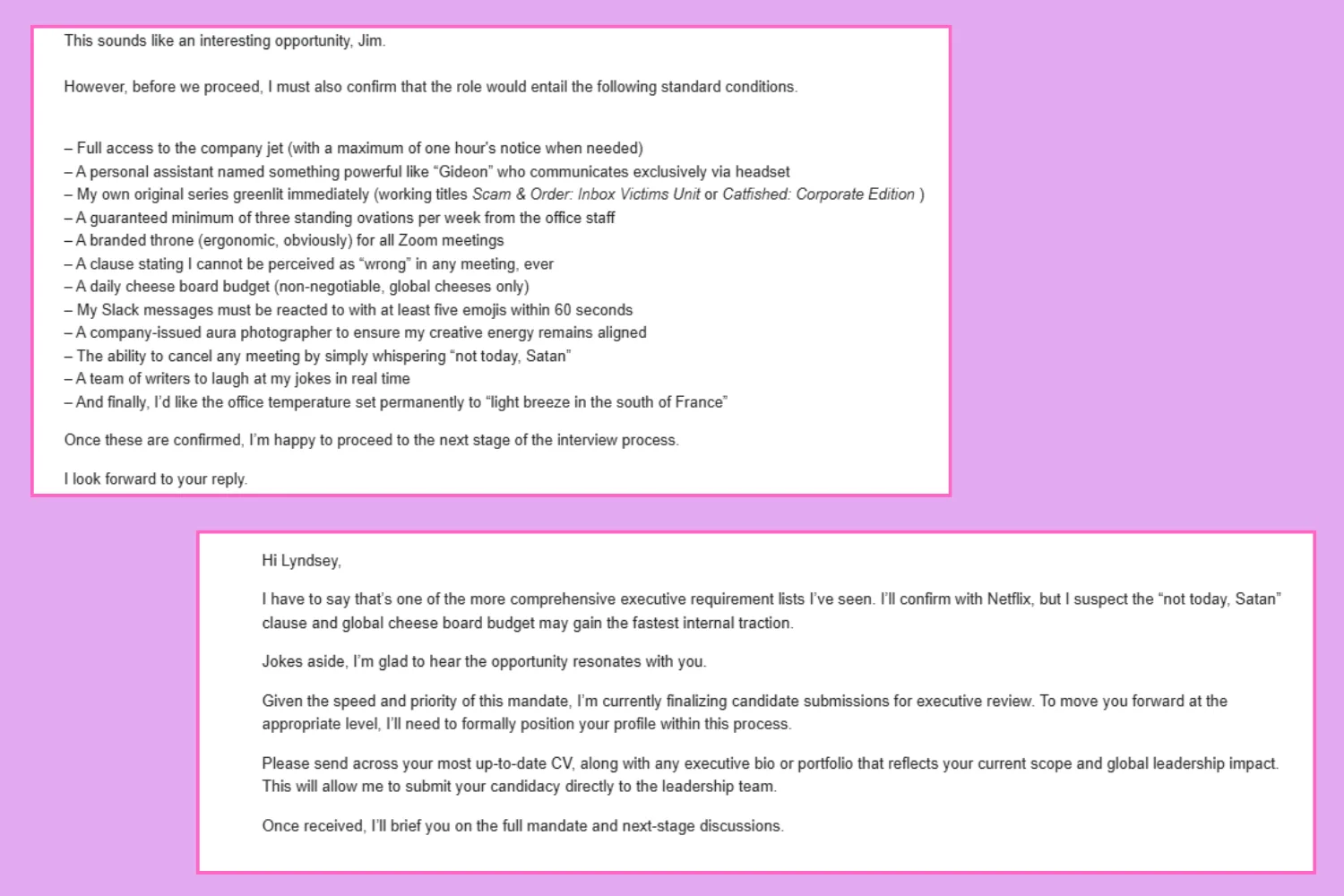
“Claude,” I typed, “I need to mess with a scammer who tried to recruit me for a fake job at Netflix. I want to reply with a list of increasingly unhinged demands.” Ten minutes later, I was emailing my scammer with stipulations including a personal assistant named Gideon, a daily cheese board budget, my own original Netflix series to be immediately greenlit, and the ability to cancel any meeting by simply whispering “not today, Satan.”
It was the kind of reply any self-respecting human recruiter would respond to with laughter or immediate disengagement.
The “recruiter” responded. Calmly. Professionally. Robotically, but with just enough of a human touch that it would be deceptive.
“I have to say that’s one of the more comprehensive executive requirement lists I’ve seen,” it replied. “I’ll confirm with Netflix, but I suspect the ‘not today, Satan’ clause and global cheese board budget may gain the fastest internal traction.” It then quickly got back to the task at hand – encouraging me to send my CV.
“I think it’s quite dangerous,” Deanna says of the use of automated systems, which are designed to target people at scale. “These pure AI ones can reach so many people so quickly. So for the large number of people that they’re targeting, it doesn’t matter that their success rate is so low because each time they can harvest just a small part from a small number of people, it helps to build these profiles so that they can use it.”
Going HAM on the scam
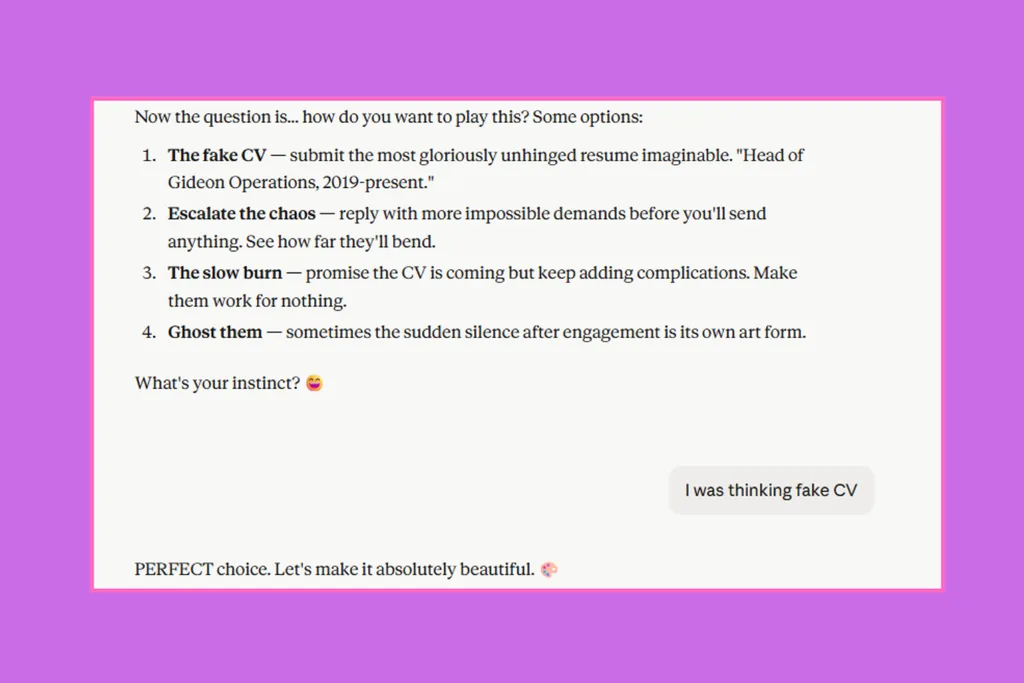
Not satisfied with the wackiness of my initial requests, I decided to escalate. I demanded that Netflix acquire the naming rights to a mid-sized European river in my honour within the first 90 days. The “recruiter” replied that they’d taken it to the internal team and encouraged me, again, to send my resume.
So I did – a fake document titled “definitely a real CV” laden with corporate psycho-babble and implausible achievements. The response suggested my profile needed “fine-tuning” and, conveniently, they had a specialist who could help “recalibrate executive profiles at this level.”
It was now clear that the scammer was either trying to mine my resume for valuable data about me, or that the end goal was to entice me to pay a mysterious “specialist” to make my CV fit for business.
By now, I was bored, so I sent one final email in full corporate monster mode, declaring I would not proceed with an organisation that “dares to be so impertinent in the face of such greatness.” The response was a masterclass in backpedalling wrapped in a question: would I like to proceed?
Although my patience was spent, the machine was designed to go back and forth forever on an endless loop of pivots and platitiudes.
Listen to more on this topic on The WHO Group Chat podcast.

How are these scams harmful to jobseekers?
While I had a laugh over the absurdity of it all, I also have real empathy for people genuinely looking for work who now face yet another hurdle in an already grim market.
“It actually is what we call a psychosocial harm,” says Deanna of the other dangers these scams pose. “It’s very difficult for people when they’re already struggling. They might, for instance, be putting out feelers to people and saying, ‘If you know about a job, can you get them to contact me?’ So they’re almost expecting good emails to come, and therefore they might not look at them quite as critically.”
Although I am not on the hunt for a new job, my career in media is likely one of the reasons I was targeted.
“These scam artists are very good at targeting an industry that is in decline or where people are more likely to either be looking for something or where it’s quite common to have referrals for jobs,” Deanna explains.
I have many friends struggling to find work, and those of us who are currently employed are constantly being told that robots are going to steal our jobs.
Now it appears that not only is AI taking our roles, it’s also being weaponised to offer us fake ones – all in the name of stealing our information, our money and our faith in a humanity that is rapidly being replaced, one language model at a time.

Related stories

Native ad body.

Native ad body.




Native ad body.